Summary
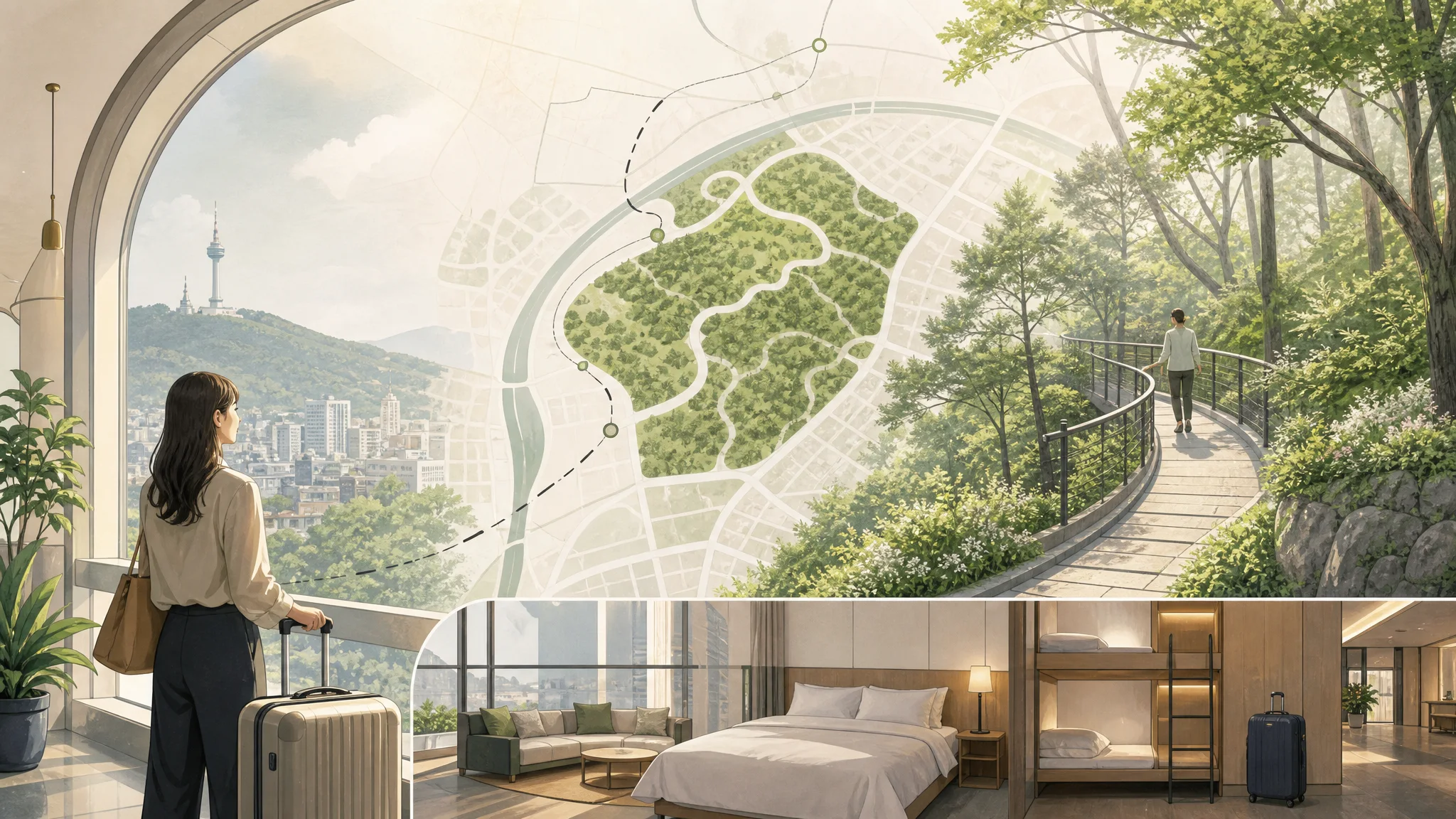
- What: The Namsan Outdoor Botanical Garden area has been redeveloped into the “Namsan Korean Forest Garden” (about 3만㎡). It’s organized around three themes—‘tradition & culture’, ‘nature & ecology’, and ‘rest & relaxation’—and contains 11 gardens. Opening date: 2026년 6월 27일.
Why go (core)
- You can experience Korean garden elements—traditional pavilions and ponds, bamboo groves and a moss garden—within the city. Noise is relatively low, there are seats and viewpoints throughout, and even a short visit can feel restorative.
Who it fits (traveler profiles)
- Families with young children: There is a 유아숲체험원 and gentle sections suitable for short walks and nature play.
- Wheelchair or stroller users: Some sections offer paved, barrier-free access, but Namsan’s terrain includes slopes—check companions’ stamina and gradient before setting off.
- Garden and outdoor photographers: Multiple photo spots such as 지당원, 영지원 and 이끼원.
- Busy local or business travelers: A 40–60 minute route fits well between urban schedules.
Transport & choosing a start point (decision rule)
- Core rule: pick the start stop to match your downhill (exit) direction for smoother circulation.
* If you plan to descend toward Namdaemun Market, Myeongdong or Namsan Library: enter from the 하얏트호텔 버스정류장 direction and follow a downhill route.
* If you plan to descend toward Itaewon or Hannam-dong: enter at the 남산야외식물원 입구 버스정류장 and loop back toward that side.
- Walking & subway: Several exits connect to Namsan, but consider road slopes and walking time—wear comfortable shoes.
Recommended route (about 40–60 minutes)
1) Enter from 하얏트호텔 버스정류장 (or 남산야외식물원 입구) →
2) Welcome Garden → 솔숲원 (barefoot/pressure-path experience) →
3) 지당원 → 죽림원 (bamboo grove) →
4) 이끼원 (stream; rest on benches) →
5) 영지원 (pond & pavilion) →
6) 남산마루 (viewing/relaxation) to finish.
(Reverse the loop to match your downhill direction for easier access to nearby accommodation and dining.)
Facilities & practical notes (field checklist)
- Admission: Free, open for self-guided visits without prior reservation. Some commemorative or docent-led interpretation programs require advance reservation and are limited to registrants.
- Restroom: A restroom is provided opposite the 유아숲체험원.
- Waste: Some trail sections have no trash bins—visitors should take their waste home (small disposable trash bags recommended).
- Mosquitoes: This is a forested area—bring insect repellent and consider long sleeves.
- Mobility: Paved and unpaved paths are mixed; some sections are accessible for wheelchairs and strollers, but slopes exist—pace with companions. Benches are available intermittently.
Accommodation connection tips (which neighborhoods/hotels to choose)
- Myeongdong / Namdaemun (Jung-gu): Central area with easy transit and shopping—good for business/chain hotels and quick access to markets after descending.
- Itaewon / Hannam-dong (Yongsan): If you prefer north-side access and nightlife/foreigner-friendly dining, boutique hotels, guesthouses and Airbnb-style stays are convenient.
- Bukchon / Insadong (Jongno): Choose hanok stays or guesthouses for a traditional experience and pair with sightseeing; consider taxi or walking time to Namsan.
- Booking note: The garden itself is free—when booking accommodation check for ‘Namsan access’ (shuttle, walk, proximity to bus stops) to minimize transfer time.
Quick prep checklist (fast check)
- Water, light snacks, small trash bag, insect repellent, comfortable shoes, camera/phone, rain poncho.
- If using a stroller or wheelchair, confirm slopes with companions (benches available along the way).
Bottom line (one line)
- Namsan Korean Forest Garden is ideal for a short urban healing walk or a focused garden photography and nature experience; pick accommodation in Myeongdong/Namdaemun (central) or Itaewon/Hannam (boutique) and choose your start point based on downhill direction to simplify logistics.