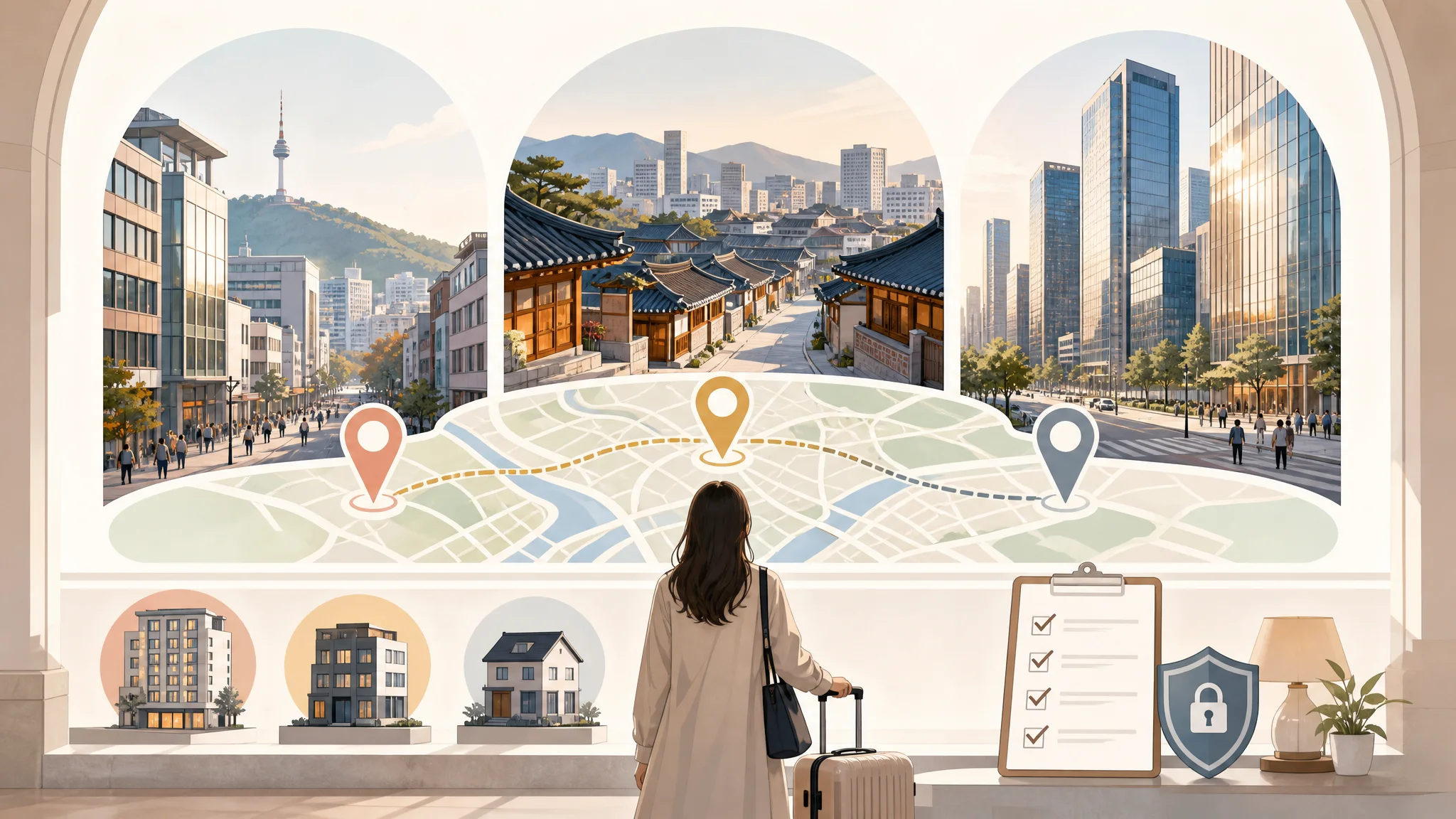
Key conclusion — If you pick a place to stay with safety as the top priority: Myeongdong (central access, tourist hubs, easy access to tourist police), Jongno/Insadong/Bukchon (traditional hanok stays, daytime-focused, quiet lanes), Gangnam (business/luxury hotels, 24-hour facilities). Below is a comparison of transport convenience, safety risks by accommodation type, and a booking/check-in checklist to help you decide.
Three areas at a glance
| Area | Recommended for | Accommodation types | Safety advantages | Transport (main subway lines) | Booking notes |
|---|---|---|---|---|---|
| Myeongdong | first-time visitors · families | small-to-mid hotels · chains | high tourist presence, well-lit streets and many shops, tourist information and tourist police available | Line 4 (central tourist access) | confirm late check-in and luggage storage options, check room soundproofing |
| Jongno · Insadong · Bukchon | culture · families · traditional stays | hanok guesthouses · boutique hotels | favourable for daytime sightseeing, quiet lanes increase perceived safety (residential areas) | Anguk (3), Jongno 3-ga (1/3/5) and other multiple lines | for hanok: confirm visiting hours, fire/open-flame restrictions, and availability of shared facilities (check fire exits) |
| Gangnam | business trips · luxury convenience | large hotels · business hotels | 24-hour front desk, security systems, hotel facilities; area remains active at night | Gangnam (2) · Shinbundang, and other Gangnam-area links | confirm 24-hour front desk, luggage storage, parking, and refund rules (recommended if you have many night-time movements) |
(Chart explanation) Items are summarised from local tourist guidance and city/district materials, focusing on safety and convenience. Narrow hanok alleyways have strong traditional appeal but are wooden structures with fire risk and possible restricted exits — verify those specifics separately.
Who these recommendations suit — trade-offs in choice
- Myeongdong recommended: travellers visiting Seoul for the first time or families with young children. Why: short night walks between attractions, dense shops and restaurants mean more street lighting and people. Downside: crowds, noise, and higher room rates during peak season.
- Jongno · Insadong · Bukchon recommended: travellers who want quiet accommodation, daytime sightseeing and traditional experiences (hanok), or who plan a lot of photography. Why: museums, cultural sites and traditional tea houses cluster here, making daytime movement convenient. Downside: narrow alleys and quieter nights mean you should check lighting and taxi access for late returns. Hanok buildings are wooden, so they commonly prohibit open flames and cooking and impose visiting-hour rules.
- Gangnam recommended: travellers prioritising business facilities or hotel conveniences (gym, lounge, 24-hour front desk). Why: many large hotels with good security and services. Downside: farther from major tourist spots, so travel time and transport costs can increase.
(When to change the recommendation) If you plan many night outings or nightlife (clubs/bars), Gangnam, Hongdae or Itaewon may be more suitable. If you have a tight budget, consider value areas such as Hongdae or Dongdaemun.
Booking & check-in safety checklist (use as checkboxes)
- [ ] Confirm 24-hour front desk/reception (important for late arrivals)
- [ ] Check street lighting and residential density around the property (night walking safety)
- [ ] Confirm presence of emergency exits, fire extinguishers and CCTV (especially for hanok and small guesthouses)
- [ ] Check cancellation and refund policies (in case of unexpected schedule changes)
- [ ] Verify room door locking system (electronic key / secondary deadbolt availability)
- [ ] Confirm the property's smoking and cooking policies (hanok may strictly prohibit due to fire risk)
- [ ] Walk time to nearest subway station (recommend 5–15 minutes) and late-night taxi access
- [ ] For children or older travellers, confirm elevator availability and stair accessibility
(Special caution for hanok stays) Hanok are wooden structures, and many hanok operators prohibit smoking, cooking or open flames. There are visiting-hour limits and quiet-hour rules for narrow residential lanes, so always confirm house rules in advance.
Real trade-offs between transport and safety
- Central areas (Myeongdong, etc.): easier movement but higher concentration of tourists requires attention to personal belongings. Tourist police and information centres are concentrated here, making reporting or assistance easy.
- Hanok areas (Bukchon, Insadong): high perceived safety during daytime but take care at night because of narrow lanes and lower activity. Check fire safety and emergency exit routes in advance.
- Business districts (Gangnam): hotels offer strong safety systems and 24-hour convenience, but repeated trips to tourist sites may increase travel time and costs.
Quick decision rules (pick fast):
- If your trip is primarily first-time sightseeing, choose Myeongdong.
- If you want traditional experiences and a quieter stay, choose Jongno · Bukchon (hanok possible).
- If your plans include late departures/returns or business needs, choose Gangnam.
Verify with local sources and statistics
- Seoul city and tourism guidance generally say most areas are safe at night if basic precautions are taken and provide emergency contacts; in an emergency, call 112.
- Police crime statistics broken down by district are published annually and can help you assess specific risks at the gu/dong level — review the latest figures for the district before booking.
(Sources summary) Official Seoul tourism guidance advises that most parts of the city are safe at night if basic safety measures are followed; hanok operating rules highlight visiting-hours and open-flame restrictions as well as fire risk; national public data provides district-level crime statistics for detailed risk checks.
If you want, tell me your budget (per night), arrival airport (Incheon/Gimpo), or whether you are travelling alone, with family, or for business, and I can recommend specific safe and practical accommodation options among these three areas (accommodation type, station access, and check-in tips).