Key summary — one-sentence conclusion
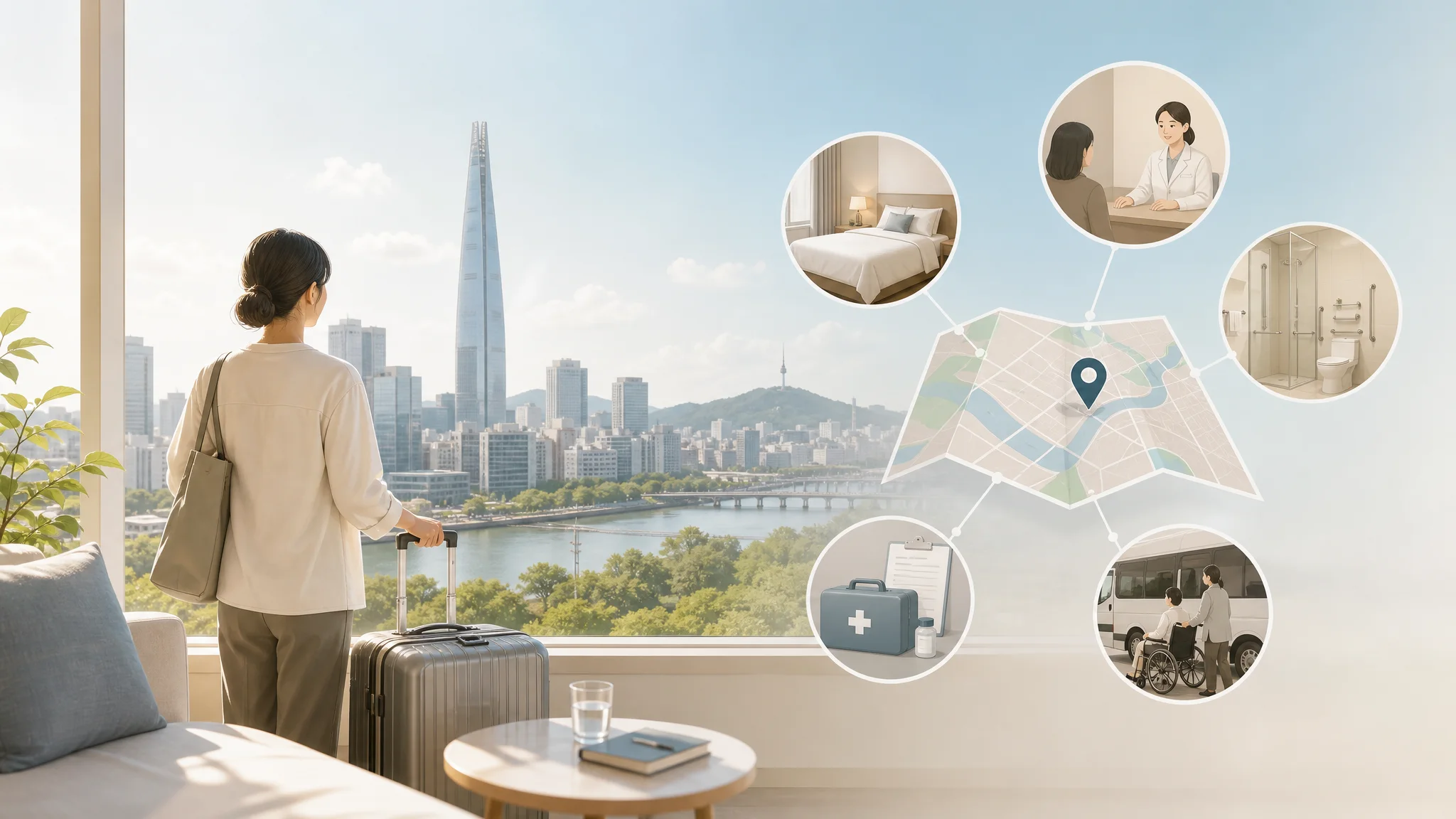
Seoul has launched a pilot call to designate “Seoul medical-friendly accommodations” to help foreign patients and their accompanying families stay safely and comfortably before and after treatment. If you are coming to Seoul for medical care, prioritize whether the accommodation offers a commute time to your treating hospital within 30 minutes by public transport, wheelchair-accessible routes, 24-hour emergency/front desk contacts, and laundry/long-stay conveniences when you choose where to stay.
What was announced — confirmed facts (brief) - Seoul is conducting, for the first time, a public call to select “medical-friendly accommodations” aimed at foreign patients and their accompanying families, taking into account recovery and long-term stays. Selection criteria include proximity to medical institutions, patient movement convenience (wheelchair routes), 24-hour emergency response systems, and laundry services and other long-stay conveniences.
- The application (document submission) period runs from 10:00 on September 14, 2026, to 18:00 on September 30, 2026, and the designation is valid for one year from the date of designation. (Document submissions follow the online form requirements.)
- Background statistics: the number of foreign patients using domestic medical institutions in 2025 rose sharply to about 2.01 million, and related foreign spending in medical services has also increased. This rising demand prompted the need to standardize 'medical-friendly' lodging services.
Who this guide helps — the trade-offs to consider - Intended audience: foreign patients and accompanying family members who plan to travel to Seoul for check-ups, surgery, procedures, or longer-term treatment (including recovery). - Key trade-off readers must weigh: proximity to the hospital (safety and ease of travel) vs. tourism convenience (shopping, dining, psychological comfort) vs. price and long-stay conditions. The optimal accommodation type depends on which you prioritize. - One-line decision rule: if medical risk or mobility limitations are high or you need recovery time immediately after same-day discharge → prioritize accommodation near the hospital (walkable or within 30 minutes). For simple outpatient or cosmetic procedures with no mobility issues, consider tourist districts or long-stay residences.
Neighborhoods and accommodation types compared (simple table) | Priority/feature | Near hospitals (medical-proximity) | Gangnam (clinic/ cosmetic & dermatology cluster) | Tourist centers (Myeongdong, Jongno, etc.) / residences | |---|---:|---:|---:| | When recommended | When hospitalization, surgery, or immediate post-discharge recovery is needed | When frequent visits to cosmetic/dermatology clinics are expected | For long stays, family accompaniment, or combining treatment with tourism | | Transport/mobility advantage | Walkable to hospital or short taxi rides → minimizes transport risk | Many clinics concentrated in one area; favorable for same-day consultations/procedures | Good access to amenities, shopping, and tourist routes; requires travel to hospitals | | Recommended accommodation types | Small-to-mid hotels, serviced residences with good access (lower floors preferred) | Business hotels, residences, some upscale hotels | Residences, apartment-style stays, hanok (short recovery stays after surgery are not recommended) | | Long-stay conveniences | Laundry, kitchenette, 24-hour front desk are important | Possible linkage with interpreters and medical coordinators (varies by property) | Kitchen facilities, long-stay discounts, convenient access to convenience stores and pharmacies |
(Note) The Gangnam area is known as a medical-tourism cluster with many cosmetic and dermatology clinics, so clinic reservations and accommodation coordination may be easier. When choosing lodging, first confirm the actual travel route and time between your treatment provider and the accommodation, and whether a shuttle is available.
Items to check before and after booking — practical checklist - Travel time to the hospital: verify public transport and taxi travel times for the day of treatment or surgery (and whether a taxi can be called in an emergency). - Room layout and accessibility: check elevator sizes, whether rooms and bathrooms are wheelchair-accessible (curbless showers vs. tubs, slip-resistant finishes), and presence of thresholds. - Emergency contact and 24-hour front desk: confirm that 24-hour staff are available and that they can handle emergency contact in English or your required language. - Laundry, kitchen, and long-stay rates: for extended stays, confirm on-site or arranged laundry services (paid or free), availability of small cooking appliances or a mini-fridge, and long-stay discounts and refund policies. - Cancellation, consecutive-night, and extension policies: negotiate flexible refund and date-change terms in case surgery is postponed or hospitalization is extended. - Pharmacy and medical-support access: check nearby pharmacy hours and whether the property arranges hospital shuttles or private wheelchair taxis.
Phrases to ask the hotel directly when booking (examples) - "Do you have a wheelchair-accessible route from the street to the room and bathroom?" - "Is there 24-hour staff and an emergency contact that can communicate in English (or my language)?" - "Is there on-site laundry or a hotel-arranged laundry service suitable for long stays?" - "What is your cancellation/extension policy for medical reasons (operation delay or extended recovery)?"
What actually changes — benefits of designated properties - Designated facilities will be promoted through Seoul’s medical-tourism platforms (multilingual) and become eligible for onsite and online promotion and participation in related networking and training events. The designation does not grant the facility any medical practice authority—medical treatment must always be provided by licensed healthcare institutions.
When this advice may change (uncertainties and variables) - If a hospital provides a shuttle or has a contracted accommodation package (a hospital-recommended lodging) → prioritizing the hospital-recommended accommodation may be reasonable. - The priority of choosing a hospital-nearby lodging varies by the type of surgery and recovery characteristics (absolute bed rest required vs. light outpatient care).
Quick printable checklist 1) Confirm public transport/taxi travel time between the treatment location (hospital name) and the accommodation 2) Confirm room wheelchair and bathroom accessibility 3) Confirm 24-hour emergency contact and language support 4) Confirm laundry, kitchenette availability, and long-stay discounts 5) Confirm refund and extension policies for medical reasons
Need more help
If you’d like—tell me your treatment schedule (e.g., consultation or surgery date), the number of accompanying persons, and your priorities (safety, cost, or tourism). I can apply the above criteria and prepare a tailored recommendation for which neighborhood and accommodation type in Seoul fits you best (for example, 'small hotel near hospital vs. long-term residence').
Sources and verification basis
- Seoul Metropolitan Government press release and public notice on the medical-friendly accommodation call (details, evaluation criteria, and application period).
- Domestic and international reporting on the rise in medical tourism and industry analysis.
Author’s note: This guide is based on Seoul city announcements published around September 13–14, 2026, and compiles practical comparison criteria and a checklist for foreign patients and their companions when selecting lodging. Check Seoul city and the Seoul Tourism Organization for follow-up notices (final designated facility lists and results).