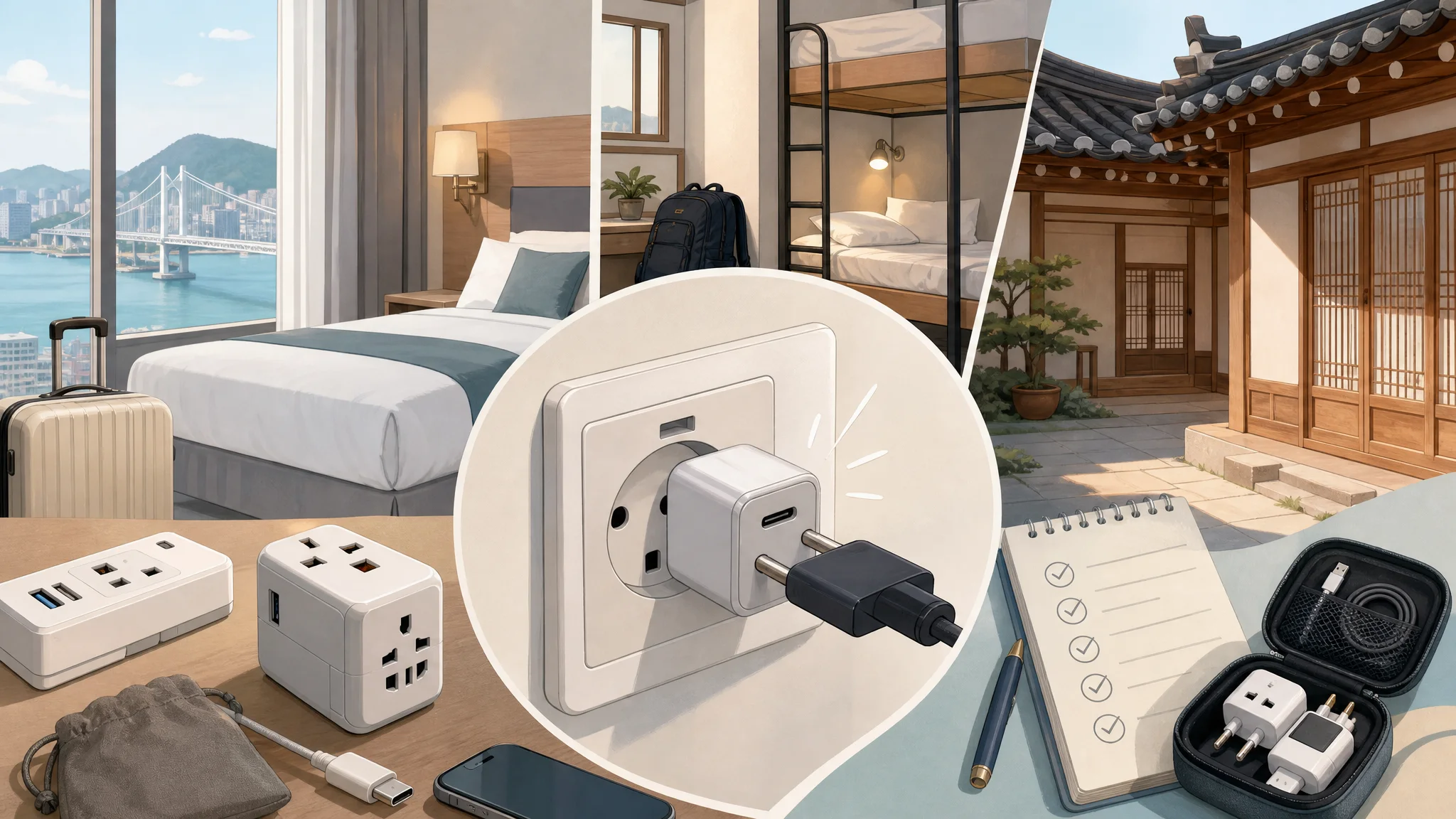
Direct answer: Most Korean accommodations use grounded (Schuko/Type F) sockets as standard; the thin Type C (Europlug) can physically fit but may not provide grounding or tight contact and can work loose. For long or high-power use or stable charging, bring a Type F/Schuko-compatible adapter or a portable USB‑C PD charging hub.
Why Type C (Europlug) falls out — technical causes
- South Korea's standard power is 220V/60Hz, and Type F (Schuko) sockets and Type C (Europlug) plugs are commonly used and generally compatible. Schuko sockets are designed with grounding clips and larger pin dimensions to ensure stable contact.
- The problem stems from the combination of pin thickness, grounding, and socket depth. The Europlug (Type C) has thinner pins and lacks a grounding connection, so it cannot make full earth continuity with a Schuko socket. As a result, internal contact pressure can be weak and the plug is more vulnerable to vibration or movement, causing adapters to loosen or develop poor contact.
- Additionally, desk-mounted, headboard, or furniture-recessed sockets are often installed shallowly; bulky universal adapters or heavy USB hubs may not sit flush and can wobble or fall out. Check both the socket depth and the adapter shape (pin diameter and body depth) before relying on a bulky adapter.
Comparison of power outlet characteristics by lodging type
| Lodging type | Typical socket situation | Charging stability (note) | Recommended items |
|---|---|---|---|
| Large hotels (chain/business) | Modern grounded (Schuko/Type F), multiple outlets at desks and bedside, frequent USB ports | Very high — suitable for high-power laptops/chargers | Schuko(Type F) adapter or C/F hybrid, USB‑C PD multiport charger (65W+) |
| Small business hotels/inns | Mixed (some grounded, some older two-pin) — watch for shallow furniture sockets | Moderate — heavy adapters may wobble | Schuko adapter recommended, lightweight USB multi-charger (use cables to reach device) |
| Guesthouses / hanok / homestays (older buildings) | Some legacy non-grounded outlets remain, fewer sockets, unreliable extension strips | Low — occasional poor contact or old outlets | Small surge-protected power strip with Schuko plug, portable USB battery, spare cables |
(Explanation) The table shows general tendencies. Within each category, outlet condition varies widely by building age and remodeling. Smaller guesthouses are more likely to retain old-style outlets.
Pre-trip and on-arrival checklist (what to bring and check)
1. Before you leave
- Charger label: if the input section lists "100–240V, 50/60Hz" you can use the charger without a voltage converter. Otherwise, a transformer may be required.
- Adapter type: bring a Schuko(Type F) adapter or a C/F hybrid. Higher-quality brands have better pin springiness and reduce wobble.
- Charging strategy: a travel USB‑C PD hub (65W or higher, 1–2 ports) plus one cable is recommended to charge a laptop and phone simultaneously; using a small hub lets you avoid leaving a heavy adapter plugged in.
2. On arrival (quick checks)
- Socket appearance: check whether the outlet is recessed and whether you can see an earth/ground terminal. If a ground is visible, using a Schuko plug is safer.
- Furniture-mounted sockets: verify whether your adapter can sit flush given the outlet depth and the adapter body size.
- High-power appliances: use the hotel's provided hairdryer or iron when possible; some household extension strips may not support high loads safely.
3. If the socket is loose or the adapter falls out
- If a thin Type C keeps falling out: request or buy a Schuko(Type F) adapter. Adapters are sold at airports, convenience stores, or large supermarkets, but availability late at night may be limited—prepare before travel when possible.
- Instead of leaving a heavy adapter plugged in, use a small multiport charger that plugs in and runs a cable to your device to avoid pull and wobble.
- If the outlet appears damaged, stop using it and ask the front desk to replace or repair it. For safety, cut power immediately if you notice overheating, sparks, or unusual smells.
Which lodging should you choose? — practical decision rules
- Rule 1 (travelers who must work / use laptops): prioritize large hotels or official business hotels. Check descriptions for number of outlets and USB charging; listings that mention "desk power outlets" or "USB charging" indicate higher reliability.
- Rule 2 (backpackers / light travelers): even at guesthouses, look for ones that state "remodeled" or have reviews mentioning "easy charging." Carry a portable fast PD power bank (20–30k mAh) as backup.
- Rule 3 (use of hairdryers, electric shavers, or other high-power devices): if you must use high-power gear, prefer hotel appliances or bring a local-rated transformer/plug (Schuko, 16A rating). Standard travel transformers are heavy and complex, so consider hotel provision or local rental where possible.
Recommended equipment (priority)
- Priority 1: Schuko(Type F) or C‑to‑F hybrid adapter (lightweight with good pin spring)
- Priority 2: 65W+ USB‑C PD dual-port charger (detachable cable) — allows laptop+phone charging from one outlet
- Priority 3 (long stays): surge-protected power strip with appropriate safety marks (KC or CE preferred)
Summary (one sentence)
In Korea, the combination of adapter type (Schuko vs Europlug), socket depth, and adapter size/weight causes C-type plugs to come loose; for stable charging bring a Schuko(Type F) adapter or a high-performance USB‑C PD hub and check outlet type or recent remodeling when booking.
(Notes) This guide is based on published technical and travel sources. Actual outlet condition varies with building age, remodeling, and room; inspect outlets on arrival.